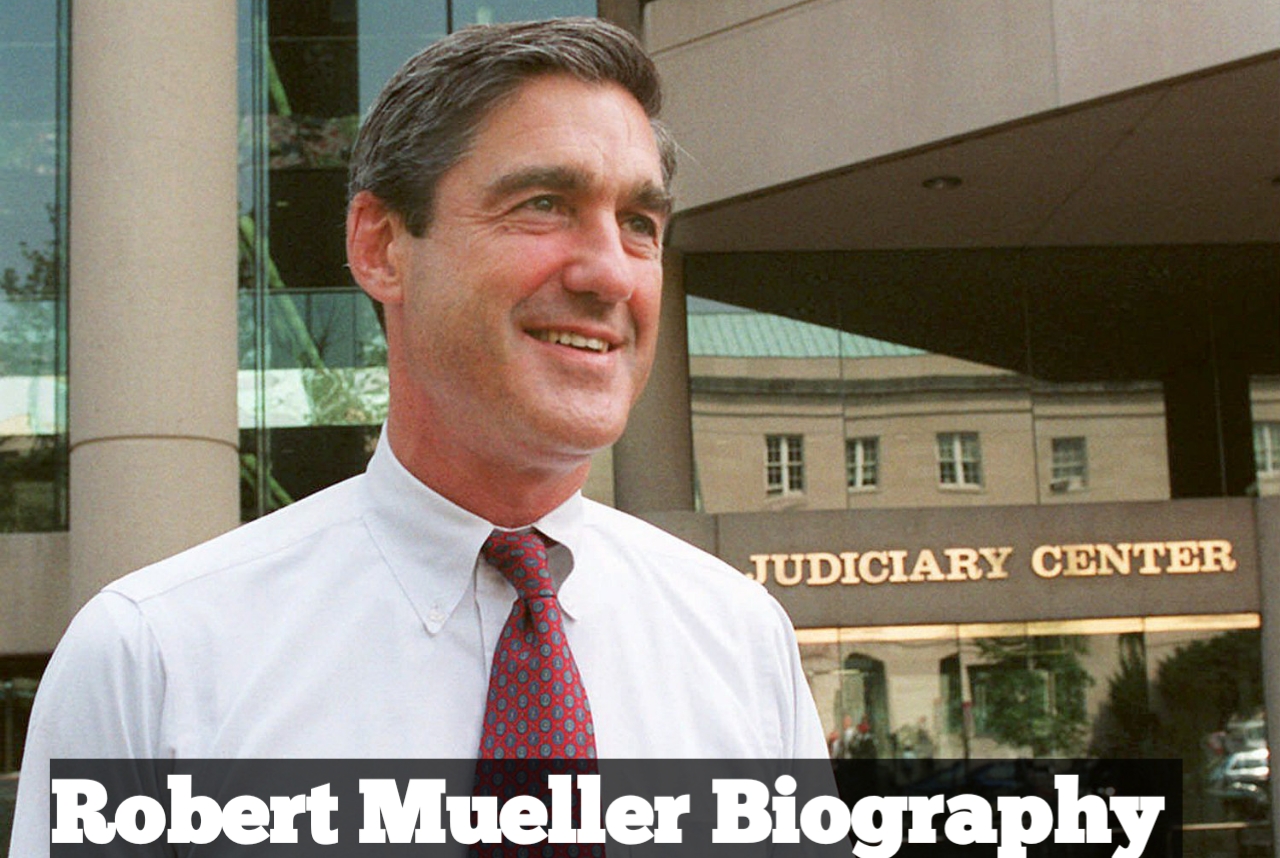

Robert Swan Mueller III was a figure who, for many, came to define the concept of the “strait-laced” public servant. Throughout a career that spanned more than five decades, Mueller moved through the highest levels of the American legal and intelligence systems, earning a reputation for an almost monastic devotion to duty and the rule of law. From the jungles of Vietnam to the director’s chair at the FBI and finally to the spotlight of a high-stakes special counsel investigation, his life was a testament to the “old-school” values of the Department of Justice.
ALSO SEE: JASMINE SANDLAS BIOGRAPHY
Early Life and Military Service
Born on August 7, 1944, in New York City and raised in the affluent suburbs of Philadelphia, Mueller’s upbringing was one of privilege, but also one deeply rooted in the concept of service. He attended St. Paul’s School, an elite boarding school in New Hampshire, where he was a standout athlete alongside future Secretary of State John Kerry.
Mueller graduated from Princeton University in 1966. While many of his peers sought ways to avoid the draft during the Vietnam War, Mueller—inspired by a teammate who had been killed in action—enlisted in the United States Marine Corps. As a second lieutenant leading a rifle platoon, he was known for his courage under fire. His military service earned him the Bronze Star with Valor, two Navy Commendation Medals, the Purple Heart, and the Vietnamese Cross of Gallantry. These formative years in the Marines cemented a leadership style characterized by discipline and a “no-nonsense” approach that would define his later career.
A Career in the Courtroom
After his military service, Mueller pursued a law degree from the University of Virginia, graduating in 1973. He briefly worked in private practice but quickly found his true calling in public service. He spent the next several decades rising through the ranks of the Department of Justice, serving as a federal prosecutor in San Francisco and Boston.
Mueller’s tenacity as a prosecutor was legendary. In 1990, under President George H.W. Bush, he was appointed Assistant Attorney General for the Criminal Division. In this role, he oversaw some of the era’s most significant cases, including the prosecution of Panamanian dictator Manuel Noriega and the investigation into the Lockerbie bombing (Pan Am Flight 103). Even when he briefly returned to private practice in the mid-1990s, the pull of public service was too strong; he eventually left a high-paying law firm job to work as a junior homicide prosecutor in Washington, D.C., simply because he missed the “front lines” of the legal system.
The FBI Years: 2001–2013
In July 2001, President George W. Bush nominated Mueller to lead the FBI. He was sworn in on September 4, 2001—exactly one week before the September 11 terrorist attacks.
ALSO SEE: UCHE MONTANA BIOGRAPHY
Mueller’s tenure was defined by the immediate and radical transformation of the Bureau. He took an agency primarily focused on “bank robbers and mobsters” and pivoted it toward counterterrorism and intelligence gathering. This was a monumental task that required overhauling the FBI’s technology, culture, and mission. His leadership was so respected that in 2011, when his 10-year term was set to expire, President Barack Obama asked him to stay on for an additional two years—a request the Senate granted with a rare 100-0 vote.
Special Counsel and Later Years
After retiring from the FBI in 2013, Mueller returned to private life at the law firm WilmerHale. However, his most famous—and controversial—assignment was yet to come. In May 2017, following the firing of James Comey, Mueller was appointed Special Counsel to investigate Russian interference in the 2016 election.
For two years, Mueller operated with his trademark silence, refusing to leak information or engage with the media. The resulting “Mueller Report,” released in 2019, was a sprawling document that detailed extensive Russian efforts to influence the election but stopped short of concluding that the Trump campaign had conspired with Russia, while also notably not exonerating the President on charges of obstruction of justice.
Legacy and Passing
Robert Mueller passed away on March 20, 2026, at the age of 81, following a private battle with Parkinson’s disease. He is survived by his wife of nearly 60 years, Ann Standish, and their two daughters.
Mueller’s legacy remains a subject of intense debate in a polarized political climate, but among those who worked with him, he is remembered as the “ultimate G-man.” He belonged to a disappearing era of civil service where the goal was not personal fame or political gain, but the steady, silent application of the law. Whether in a foxhole in Vietnam or a hearing room on Capitol Hill, Robert Mueller remained a figure of unwavering, if sometimes stern, consistency.
Death and Age
Robert Mueller passed away on March 20, 2026, at the age of 81. According to statements from his family and reports from major news outlets like NPR and the New York Times, he died in Charlottesville, Virginia. While a specific cause of death was not immediately shared in the family’s brief statement, it was widely known that he had been privately battling Parkinson’s disease since at least 2021.
Political Party
Mueller was a lifelong Republican. Despite his party affiliation, he was often described as a nonpartisan or “institutionalist” figure. His career was marked by appointments from both sides of the aisle:
- Appointed by Republicans: George H.W. Bush (Assistant Attorney General) and George W. Bush (FBI Director).
- Requested by Democrats: Barack Obama (who asked him to extend his FBI term by two years).
Because of his role as Special Counsel investigating the Trump campaign, he became a polarizing figure late in life, often facing criticism from within his own party while being defended by many Democrats.
ALSO SEE:FEMI DAPSON BIOGRAPHY
Connection to the Epstein Investigation
In the year leading up to his death, Mueller’s name surfaced in relation to congressional inquiries into the Jeffrey Epstein case.
- Subpoena: In 2025, the House Oversight Committee issued a subpoena for Mueller to testify regarding the FBI’s handling of the Epstein investigation during his tenure as Director (specifically the 2008 non-prosecution agreement).
- Withdrawal: The committee later withdrew the subpoena in September 2025 after learning of Mueller’s declining health and his Parkinson’s diagnosis, which made him unable to participate in a deposition.
- Epstein Files: Documents released in recent years mentioned that Epstein had been monitoring Mueller’s appointment as Special Counsel in 2017, viewing it as a significant threat to then-President Trump.
