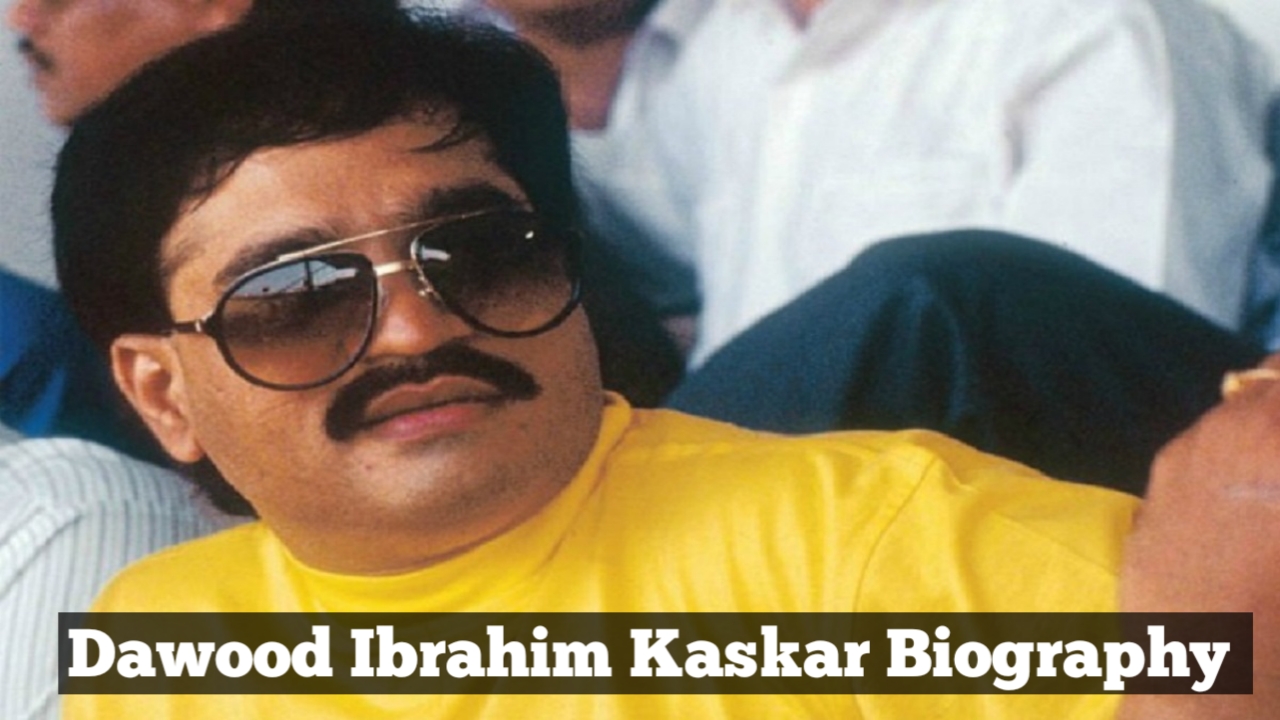
The life of Dawood Ibrahim Kaskar is a narrative that traces the transformation of a Mumbai street hustler into one of the world’s most elusive and dangerous fugitives. Often referred to as the “Don of Dongri,” his story is inextricably linked to the evolution of organized crime in India and the subsequent blurring of lines between the underworld and international terrorism.
Early Life: The Constable’s Son
Born on December 26, 1955, in Khed, Maharashtra, Dawood Ibrahim grew up in a Konkani Muslim household. His upbringing was characterized by a sharp irony: his father, Ibrahim Kaskar, was a respected head constable in the Mumbai Police Crime Branch. Despite being raised in a home governed by the law, Dawood and his elder brother, Shabir Ibrahim Kaskar, were drawn to the gritty, lucrative allure of the streets.
Living in the Temkar Mohalla area of Dongri, Dawood eventually dropped out of Ahmed Sailor High School. In the 1970s, Dongri was the epicenter of smuggling and gang activity. Dawood began his criminal journey as a petty thief and fraudster but quickly graduated to more organized ventures under the tutelage of local mobsters like Bashu Dada.
The Rise of D-Company
The late 1970s and early 1980s marked the birth of D-Company. Initially, Dawood and Shabir operated as a small gang, but they rose to prominence by filling the power vacuum left by older dons like Haji Mastan and Karim Lala. Unlike the traditional “Robin Hood” personas of earlier gangsters, Dawood’s syndicate was built on clinical efficiency and diverse revenue streams, including:
- Gold Smuggling: Taking advantage of India’s high import duties.
- Real Estate: Using muscle to settle land disputes and “redevelop” properties.
- Extortion: Taxing the wealthy and the thriving Bollywood film industry.
A pivotal moment occurred in 1981 when the rival Pathan gang murdered Shabir Kaskar. This sparked a bloody gang war that saw Dawood systematically eliminate his competitors, eventually making him the undisputed king of the Mumbai underworld. By the mid-1980s, the pressure from Indian law enforcement forced him to flee to Dubai, where he continued to run his empire remotely.
ALSO SEE: SEAN PENN BIOGRAPHY
The 1993 Mumbai Bombings: A Dark Metamorphosis
The trajectory of Dawood Ibrahim changed forever on March 12, 1993. In retaliation for the communal riots following the demolition of the Babri Masjid, a series of 12 coordinated explosions rocked Mumbai, killing 257 people and injuring over 700.
Indian intelligence agencies identified Dawood as the primary financier and mastermind behind the attacks, working in conjunction with Tiger Memon. This event shifted his status from a “smuggler-don” to a Global Terrorist. The bombings also caused a massive rift within D-Company; his most prominent lieutenant, Chhota Rajan, split from the group on “patriotic” grounds, leading to a decade of international assassinations between the two factions.
ALSO SEE: UCHE MONTANA BIOGRAPHY
Global Operations and Sanctions
Following the 1993 attacks, Dawood reportedly relocated to Karachi, Pakistan. Over the next three decades, his operations expanded into a multi-continental network involved in:
- Narcotics: Controlling drug routes from the Golden Crescent.
- Money Laundering: Utilizing the hawala system to move billions of dollars.
- Counterfeit Currency: Allegedly producing high-quality fake Indian currency notes (FICN).
In 2003, both the United States and the United Nations designated him a global terrorist. The U.S. Treasury Department highlighted his ties to Al-Qaeda and Lashkar-e-Taiba, noting that his smuggling routes were shared with Osama bin Laden’s network. Today, he remains on the FBI and Interpol’s “Most Wanted” lists with a bounty of $25 million on his head.
Present Status and Legacy
As of 2026, Dawood Ibrahim remains a phantom. While Indian dossiers consistently place him in high-security enclaves in Karachi—listing specific addresses and Pakistani passports—the Pakistani government continues to officially deny his presence. Rumors regarding his failing health or potential death have surfaced periodically over the years, yet none have been verified.
His legacy is a cautionary tale of how organized crime can evolve into a threat to national security. He remains a symbol of the “Deep State” complexities in South Asia, moving from the narrow lanes of Dongri to the center of global geopolitical tension.
Net Worth
Estimating the net worth of a global fugitive is complex, as most of his assets are tied up in “shadow” economies and Benami properties.
- Estimated Total: Approximately $6.7 billion to $7 billion.
- Global Real Estate: He reportedly holds massive investments across 50 countries, including significant holdings in the UAE, UK, Morocco, Spain, Singapore, and Pakistan. In 2017, the UAE government reportedly seized assets worth approximately $2.2 billion (₹15,000 crore) linked to his syndicate.
- Revenue Streams: His wealth is sustained through drug trafficking (the “Golden Crescent” routes), illegal arms trading, money laundering (Hawala), and extortion.
Personal Life: Wives and Family
Dawood’s personal life is a mix of long-standing domesticity and more recent controversy.
ALSO SEE: NORA FATEHI BIOGRAPHY
- First Wife (Maizabin/Mehjabeen Shaikh): She has been his primary partner for decades. Recent reports from his nephew (Alishah Parkar) to the National Investigation Agency (NIA) suggest that she remains in Karachi and maintains contact with family in India via encrypted messaging apps.
- Second Wife: In early 2023, reports surfaced that Dawood had remarried a Pakistani Pathan woman. While he allegedly claimed to have divorced Maizabin to facilitate this, family sources suggest he is still married to both.
- Children: He has three daughters (Mahrukh, Mehreen, and Maziya) and one son (Moin Nawaz). Most notably, his daughter Mahrukh is married to Junaid Miandad, the son of legendary Pakistani cricketer Javed Miandad.
Current Age
- Born: December 26, 1955.
- Current Age: As of today, March 19, 2026, he is 70 years old. He will turn 71 at the end of this year.
Movies Inspired by Dawood Ibrahim
The Indian film industry has long been fascinated by his rise and the “D-Company” lore. Here are the most prominent films:
| Movie | Year | Connection / Character |
|---|---|---|
| Dhurandhar 2 | 2026 | Features “Bade Sahab” (played by Danish Iqbal), a character heavily inspired by an aging Dawood. |
| Once Upon a Time in Mumbaai | 2010 | Emraan Hashmi’s character, Shoaib Khan, is a direct fictionalization of a young Dawood. |
| Black Friday | 2004 | A gritty docu-drama detailing his role in the 1993 Mumbai blasts (played by Vijay Maurya). |
| Company | 2002 | Directed by Ram Gopal Varma; explores the relationship between a don (inspired by Dawood) and his lieutenant (inspired by Chhota Rajan). |
| D | 2005 | A prequel to Company, focusing specifically on the origin of the D-Company syndicate. |
| Haseena Parkar | 2017 | Follows his sister’s life, with Siddhanth Kapoor portraying Dawood. |
| D-Day | 2013 | A |
Leave a Reply