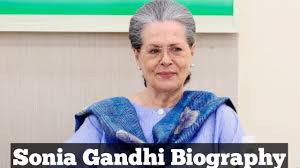

Sonia Gandhi’s life is a remarkable study of an individual who, despite being born into a modest Italian family and initially harboring a deep-seated aversion to the spotlight, became one of the most powerful and influential figures in the history of the world’s largest democracy. Her journey from the quiet streets of Orbassano to the corridors of power in New Delhi is a narrative of personal tragedy, immense resilience, and an unusual brand of political leadership that prioritized influence over office.
Early Life and the Cambridge Connection
Sonia Gandhi was born Edvige Antonia Albina Maino on December 9, 1946, in Lusiana, Italy. Raised in a traditional Roman Catholic household near Turin, her upbringing was far removed from the complexities of Indian geopolitics. Her father, Stefano Maino, was a building contractor, and the family led a middle-class life defined by conservative values.
ALSO SEE: MICHAEL SODIENYE DAPPA BIOGRAPHY
In 1964, seeking to improve her English, Sonia moved to Cambridge, England, to attend a language school. It was here, in 1965, that she met Rajiv Gandhi, the elder son of then-Indian Prime Minister Indira Gandhi. Rajiv was studying mechanical engineering at the University of Cambridge. Their meeting in a small Greek restaurant famously resulted in “love at first sight.” Despite initial reservations from both families—owing to the vast cultural and linguistic divide—the couple married in a simple ceremony in New Delhi in 1968.
The Reluctant Housewife
For the first two decades of her life in India, Sonia Gandhi was a “reluctant” member of the first family. She stayed away from politics, focusing instead on raising her two children, Rahul and Priyanka, and supporting her husband’s career as a commercial pilot for Indian Airlines. She even resisted Rajiv’s entry into politics after the death of his brother, Sanjay, in 1980, fearing the toll it would take on their family.
However, the assassination of her mother-in-law, Indira Gandhi, in 1984 forced a change. Rajiv was thrust into the role of Prime Minister, and Sonia stepped into the role of the Prime Minister’s wife. Even then, she remained a private figure, often appearing only as an official hostess or accompanying her husband on state visits. Her world was shattered once more in 1991 when Rajiv Gandhi was assassinated by a suicide bomber during an election campaign in Tamil Nadu.
Entry into Politics: The “Savior” of Congress
Following Rajiv’s death, the Indian National Congress party, facing leadership vacuums and internal fractures, pleaded with Sonia to take the reins. She refused for six years, choosing a life of seclusion and focusing on the Rajiv Gandhi Foundation. However, by 1997, with the party’s fortunes at an all-time low, she finally relented and joined as a primary member.
In 1998, she was elected President of the Congress Party, a position she would hold for a record-breaking 19 years (and later as interim president). Her leadership was initially challenged by critics who pointed to her “foreign origin.” Three senior leaders even split from the party over this issue, but Sonia’s “Inner Voice” speech and her grassroots campaigning eventually silenced many detractors.
ALSO SEE: SEAN PENN BIOGRAPHY
The Era of the UPA and “The Great Sacrifice”
Sonia Gandhi’s greatest political triumph came in 2004 when she led the Congress-led coalition, the United Progressive Alliance (UPA), to an unexpected victory over the BJP. While the path was clear for her to become Prime Minister, she made the stunning decision to decline the post. Citing her “inner voice,” she instead nominated economist Dr. Manmohan Singh for the position.
This move was seen as a masterstroke that neutralized the “foreign origin” debate and cast her as a selfless leader in the tradition of Indian renunciation. As the Chairperson of the National Advisory Council (NAC), she remained the ideological anchor of the government, championing landmark social welfare legislations such as:
- The Right to Information (RTI) Act
- The Mahatma Gandhi National Rural Employment Guarantee Act (MGNREGA)
- The Food Security Bill
Legacy and Later Years
Under her guidance, the UPA won a second term in 2009, though the second decade of her leadership was marred by corruption scandals within the government and the rise of a powerful opposition. In 2017, she stepped down as party president, handing the mantle to her son, Rahul Gandhi, though she remained a pivotal figure as the Chairperson of the UPA and later the INDIA bloc.
Sonia Gandhi’s biography is not just the story of a politician; it is the story of a woman who navigated the complexities of a foreign land, survived profound personal losses, and eventually shaped the destiny of nearly 1.4 billion people. Her legacy remains a subject of intense debate, but her impact on the structural and social fabric of modern India is undeniable.
| Category | Details |
|---|---|
| Real Name | Edvige Antonia Albina Maino |
| Current Age | 79 years old (Born December 9, 1946) |
| Husband | Rajiv Gandhi (m. 1968; d. 1991) |
| Religion | Roman Catholicism |
Key Biographical Notes
ALSO SEE: UCHE MONTANA BIOGRAPHY
- Birthplace: Lusiana, Vicenza, Italy.
- Citizenship: She held Italian citizenship until 1983, after which she became a citizen of India.
- Marriage: She met Rajiv Gandhi in Cambridge, UK, in 1965. They were married in a Hindu ceremony in New Delhi in 1968.
- Religious Background: While she was raised in a traditional Roman Catholic family and remains a practicing Catholic, she has lived a life deeply integrated into Indian traditions and the secular political fabric of the Nehru-Gandhi family.

Leave a Reply